Pennsic 48

So that was a thing. It’s an amazing thing. It’s a medieval city that pops up in the middle of nowhere over a few weeks, around a war. For me, the only bits of the war I hear about comes from campmates who return sweaty and exhausted and chattering about tactics and reliving hits and who gets the shower first and repairs that need to happen before they do it again tomorrow.

img_20190727_165503024_burst000_cover_top

Waiting to troll in

A word of warning, I am just as awful about taking pictures at Pennsic as I am everywhere else. This is gonna be a lot of rambling, and not a lot of pretty pictures. Sorry about that, you’ll have to close your eyes between paragraphs and pretend.

For me, Pennsic is about A&S. (I’m sure you’re all shocked, based on the name of this blog and all of the content to this point.) I spent 2 weeks, top to bottom, A&S. From peace week projects in camp (usually garb I hope to wear <cough>), to helping out at University point, to taking classes (and teaching classes), and chatting with other artisans I meet, to A&S display, both looking at everything and helping with the consults to a full day of A&S war point. (Oh hey look at that, we do contribute to the war effort, a teeny little bit.)

We’ve a mix of talents in camp: from experts in sewing, to woodworkers, to blacksmiths, textiles, brewers, cooks and of course everything that all of the curious natures in camp have poked their noses into, even if not an expert. There’s a lot of questions asked, and answered, and written down to look into more later (or googled). It’s amazing. I can only presume that most camps are like this, cause most SCAdians have so much knowledge crammed in, it can’t help but burble out, but I can only speak for our camp.

This year, I managed to take a couple of classes (one of Cariodoc’s middle eastern food classes, and a warp weighted loom class), taught my saponification class (more on that in a moment), volunteered at University point, helped out with consults at A&S display (and got a lot of good gawking in). I got to stop by a friend’s vigil AND got a see a friend elevated to laurel in a drive by. I managed to be out and about enough to catch some of a friend’s camp’s song night, and finally got to see midnight madness. I got to visit the hot stone brewing setup, and got to help out a smidge at war point and judge all day. Phew. It was a busy year, but it was good.

img_20190803_152258711_hdr

Yeast ring at the brewing demo

Saponification class was held, by sheer dumb luck (or exceptionally cleverness by the scheduling people!) immediately following one of Mistress Elska’s hands on classes in soap making. It was perfect. I had 5 students, and 4 of them arrived with their bottles of proto-soap, answering perfectly the ‘how many of you have made soap before?’ question. It went well. It doesn’t go for a whole hour, so I can add more information, but I do fear overwhelming people with info, so I’ll have to consider that for next time. The modern alchemy series seems to be moderately popular.. I’m teaching the mordents one again at Althing. I need to see if there’s anything I want to revise in that one. FooL feels so very long ago at this point.

I’m really pleased with how well the body held up this year. Every year has been better for the joints than the last. It’s almost like years of physiotherapy and healing actually helps, even with degenerative issues. It was the sort of year where I didn’t die walking home after the buses stopped running, and where I ended up downtown (or back in camp) having forgotten my cane somewhere. When you feel hale enough to forget your cane places, it’s a damn fine sign. I still have to be careful, and aware not to overdo it, but that line is getting pushed further and further, and I’m damn pleased by that reality. I’ll take it for as long as I might have it, won’t be forever, but I’ve got it for now.

img_20190811_072432626

My new mug

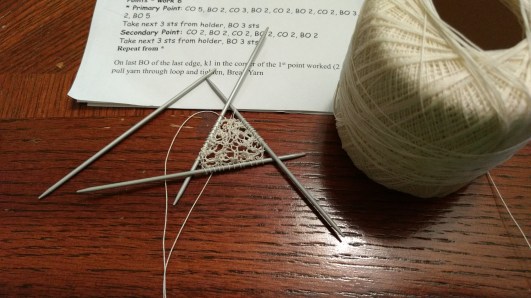
Tiny knitting

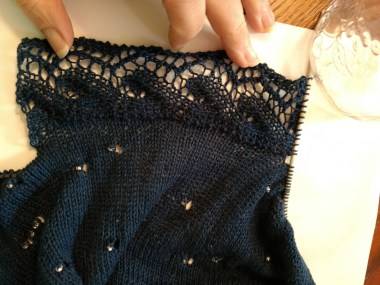
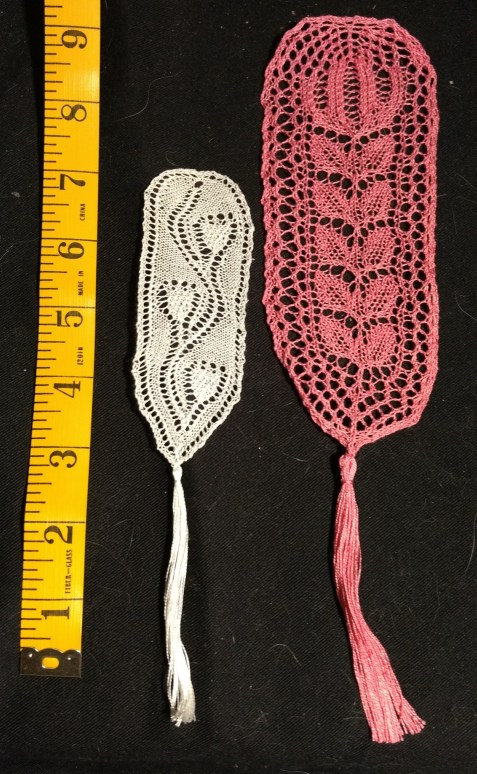
I am rather fond of my tiny knitting. I’m noted for working tiny, and I enjoy the heck out of it. Knitted lace out of size 30 crochet cotton is one of my happiest places. (Totally not SCA period, don’t even try. Think 19th and 20th centuries for that, and it doesn’t make it any less ❤ for me. )

What’s tiny? This differs for everyone, IMO, but pretty much if it’s more thread than yarn, it probably qualifies as tiny knitting. Certainly the article that’s been making the rounds about 80 stitches to the inch is tiny, but that’s an extreme. (I’ve never gotten much finer than about 32 stitches to the inch, but hey, perhaps it’s time for a virtual grudge match.)

img_20170412_171438929

I get a lot of requests to teach classes in tiny knitting, but it’s hard to get across the details in a class setting. Instead, while I’m starting <cough> another tiny knitting swatch for another piece, I figured I’d hit the highlights in blog form.

This is not a beginner project

I mean, I hate telling beginners ‘oh you shouldnt do that thing you really want to, go knit a dishcloth’. I hate it a lot. I am a firm believer in learning on a project that makes you happy, because then you’re motivated to actually progress. That being said.. shove knitting XP into other things before you dig out the thread and sub 2 mm needles. Hell, you want to start small, start with a sock (or two or ten). Sock yarn is small but not tiny, it gets you in the right habits. (Also, home knitted socks are delightful. It’s a lovely way to shove XP in a skill)

img_20170924_191156499

The first row(s) will suck.

This is a given for any project, but somehow it is felt so much more keenly when working in silk at (approx) 20 stitches to the inch. (A bazillion times more when you’ve got 8 stitches on 4 needles and they all want to fall out. Thank you doilies.) You get everything cast on, and you start knitting, probably in the round, and it sucks. The first row, or two.. sometimes even three.. suck. Always. Tension is weird, and stitches aren’t quite sliding right, and there’s nothing holding it together in the round and gnngh. It will get better. Keep knitting.

Starting over is not the end of the world

Sometimes, it doesn’t get better. Sometimes there’s a catastrophic dropped stitch and any efforts to catch it are just .. just no. Sometimes, there is less wailing and gnashing of teeth when you pull out the needles and reclaim the thread. This is not the end of the world. Look at all that xp you just put into this pattern! Win! (Still frustrating

as all hell, don’t get me wrong, but it happens. It’s okay.)

img_20190724_130833513

Good light is not optional

This might be less of a concern for those knitters who are under 35, but certainly for those of us who creep ever higher in that age tally, good light is essential. Actual natural daylight is the gold standard of good lighting, but let’s be realistic about the approaching winter, and the fact that I’m indoors a lot. The lighting sucks. I swear by my Ott light, but any good bright light is a boon. Some people swear by a lighted magnifier, I find it really distractingly disorienting, but see what works for you. Save knitting in the movies for when you’re doing a plain vanilla dishcloth or something.

img_20180902_175910637

This is not a weekend project

This seems to sneak up on people, and it should be obvious, but it is worth repeating. When you need to do 20 stitches (or more) to get an inch worth of stitches, there is a lot of knitting in a piece with tiny stitches. A few mm of progress is significant. This is not going to whip up in a weekend, so zen into the process. You’ll get there eventually. I find that crossing things off on the pattern really helps give me visual cues that progress is being made.

img_20170413_055435358.jpg

Practice in cotton

Or in wool, if you prefer, but if your aim is to knit in silk, then practice in cotton. Wool has stretch, it’s more forgiving to colour work, it’s more forgiving in general. Silk, and cotton are both threads with not a bit of elasticity, and they will put you in your place and show you want they don’t like, even if wool is easy going about it. There is no shame at all in doing pieces in cotton. It’s cheap, it’s easy to find, comes in a variety of sizes and if you rip it out 10 times and it’s grotty, it’s cheap enough to throw out. Know that different cottons /do/ look and work differently. Cotton can be mercerized or not, which affects its hand and shine. (Mercerized is more shiny, non is not)


Crochet cotton usually starts at about size 5 and as the number goes up, the size goes down, which makes it very natural for progressing through sizes as you want to try smaller work. My tension is unusual (aka bullet proof tight usually) so suggestions on needle sizes vary wildly, but for solid fabric I’m usually about 1mm needles with size 20 yarn, and for ethereal lace, I’m usually 3 mm needles with size 30 cotton. There’s no firm answer on needle size, use what gives you a fabric you like, your tension is yours.

I love tiny knitting, I love the challenge, I love the complexity, I love the satisfaction. The reality of slow progress is one I can live with, but tiny knitting isn’t really something one can teach in an hour’s class. Knit, and knit lots. Find something you love, and knit it smaller than you usually would. Do that lots.

Book Review: Textiles and Clothing c. 1150 – c. 1450

This is another book that I’ve conjured out of the library, and figured I’d share my thoughts on before I send it back to its humans. It’s from the Medieval Finds from Excavations in London series, number 4. Textiles and Clothing c. 1150 – c. 1450 written by Elisabeth Crowfoot, Frances Pritchard and Kay Staniland and published by The Boydell Press in 1992, with a second edition in 2001.

img_20190717_145039122

As you may have guessed from the series it is in, it’s got a rather narrow focus on a selection of finds from London itself, primarily carried out in the 1970s and 1980s, and within about a 300 yr time scale. My personal interest falls both before and after those 300 years, but that’s besides the point. I don’t mind that it’s got a moderately tight focus, it feels as if it can do a better job of looking at what it’s got rather than try and be all things to all people.

They spend a chunk of time discussing the challenges of textile archeology and the digs themselves, and then devote themselves to many chapters of fairly typical examination. Fibre content, weave structure, details on the spinning of the fibres, and speculation on dyes. It is delightfully detailed, and the wool chapter alone is a good read, but the addition of a chapter about goathair is an unexpected delight.

They do an excellent job of putting the finds into context of every day life, not just looking at the textile alone, but also mentioning where such textiles were found in inventories and wardrobe accounts to discussions of the various textile industries in their focus time period. This is not uncommon in various textile accounts, but is always welcome.

Probably my favourite chapter from the book is the one on sewing techniques and tailoring. How were the seams put together? What thread did they use? How long did it take to make a certain garment? It’s these niggly details that I appreciated someone gathering up and trying to make basic sense out of, and those are the ones that many who are interested in as close to re-enactment as possible want to work with. It’s an excellent chapter, and if you read only one out of the book, that’s the one to start with. (Also the last chapter, it was rather like dessert).

The book has no index, but rather a glossary and an extensive bibliography, as well as a concordance of all of the finds from each dig categorized by fibre, if you prefer to look things up that way.

All in all, another book that I was very happy to spend some time with. Another book that I’m not sure I need to have on hand at all times, but one that I appreciate having access to. I wish it was slightly closer access than borrowed from the library of another city, but that’s not so bad, all things considered.

Heddles!

We have heddles!

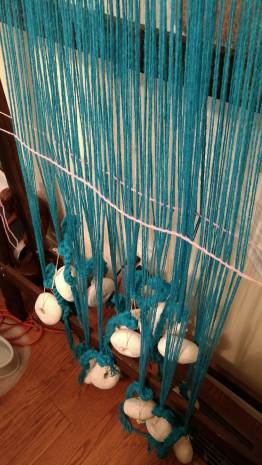
Yes, it’s exciting enough for me to make it a big bold statement. For those wonder what the devil I’m talking about, allow me to give a smidge of background. I’m working on a weaving project on a warp weighted loom. I got the warp tied on, and chained up and tied to weights. So far so good. I declined to add a tablet woven band at the top because it’s just a practice piece, and I am wholly and firmly unconvinced that it’s an always thing. (More research needed, clearly). I’d say ‘fight me!’ about it, but really, just bring references about my wrongness would be sufficient. Proving an ‘always’ is hard at the best of times, and when we’re talking an era with little extant evidence to begin with.. well.. I don’t think I’m out in left field here.

img_20190525_075442954

And then it sat.

And it sat. And it stared at me balefully as I worked around it in our main room. (It’s not smack in the way, but it’s rather in the way). And I did other things, and I came up with all sorts of excuses not to work on it. Because I had to put the heddles on next, and I was being a wimp about trying something new. I’m a pretty experienced string person, and paralyzed by the notion of doing something new with string.

After a fairly solid conversation with my own head, and slotting in some downtime to actually recover enough cope for new things (is that just me? New things are too much when everything else is a mess.), I got out the instructions. And lo and behold.. the instructions that were promised to be easy to get the hang of were.. easy to get the hang of!

Let me back up a moment.. heddles. Great word.. weaving is full of great words really, but apparently weavers are incapable of using words that anyone else does. Heddles are the things that pull just some of the warp threads up at any given time. In plain weave (over, under, over, under) you stick heddles on half the threads, such that you can grab that half and pull them up when you need, or push them back when you don’t need. Fancier patterns require you to have just some pulled up, and then just others.. and hey.. if you have 4 different configurations of what threads you have heddled.. that’s a four shaft loom! In warp weighted looms, each configuration is a stick (rod.. dowel in my case) that has strings tied from the rod looped around a warp string. If you want a fancier pattern, you have more heddle rods. I have a very basic pattern (over, under.. it’s called tabby or plain weave.. see? All new words.), so I only need one heddle rod with half my warp threads tied on.

img_20190716_093844582

I get it all tied, and I take that lovely picture above and then I pause. And I realize that I have successfully put the heddle rod behind my warp. So the warp can’t move freely in their loops. So I need to take it all out, because I am an idiot.

I did get lots of practice in tying heddles, and it is now heddled up correctly, even if I forgot to get a photo of the current state. On to weaving next! (Post Pennsic at this point)

A&S at Pennsic 48

Are you putting together your Pennsic schedule and thinking ‘Gosh, I wish I knew when the A&S awesome was’.. this post is here to help!
(Those of you at home need to put together homemade A&S awesome, hopefully you’ll share all the cool stuff you got up to while some of us are down in PA!)
 
First off, Pennsic University offers classes beyond the wildest imagination, on every topic you can think of, and a few you probably hadn’t thought of. The teachers are from all over the Known World, and getting new perspective is super cool, as well as learning new things! Those can be found in the Thing (yes, seriously called Thing). http://thing.pennsicuniversity.org/
(Yes, I put on the big kid pants and signed up to teach. I’m not in the book, but I am in Thing, and should be in the ‘additions and cancellations’ sent to the paper as well. Look for Modern Alchemy: Saponification)
Not wanting to commit to classes, but just want to gawk at the awesome? Got you covered. Middle Sunday 1 pm – 5 pm is the A&S display. Both the adult and youth display are at the same time this year! Two for the price of one. Anyone can bring what they are working on and show it off. We get rank beginners showing their very first piece all the way through people bringing the body of work that they’ve been working on for years. No judging, no prizes, just A&S geeks geeking out with other A&S geeks. http://www.pennsicwar.org/penn48/DEPTS/AANDS/DISPLAY/index.html
Last, but absolutely not least, is A&S war point on Thursday of War week, 10a – 4p. Why should the martial types get all the fun of acquiring points towards the war!? 10 artisans from Middle and allies vs 10 artisans from East and allies compete for the A&S war points. This is a judged competition, and while open to the public to come and admire the works, you’ll have to admire the other 19 while any given work is being judged.
Plenty of A&S to keep a person busy at Pennsic!

Another day, another hem.

I was lamenting to a friend that a steady diet of plain sewing was not the most exciting blog fodder in the world, but that’s what we’re up to around here atm, so that’s what I’m going to natter about for a little while.

I hand sew most of my garb. This is not a statement designed to brag, I know quite a few people who do the same, it’s mostly an acknowledgement of the strained and temperamental relationship I have with sewing machines. (The serger and I aren’t speaking again.) My usual commentary on machine sewing is ‘oh goodie, now I get to screw it up faster!’ I sat down and considered getting more Pennsic garb quickly by machine sewing and realized I’d be a happier human hand sewing slowly. Which probably meant nothing new for Pennsic, but a happier human in old garb rather than stressing myself out at the machine. Which of course meant I went and worked on hand sewing an early period tunic for the late period spouse. Tunics, as in more than one. Two early period tunics for the late period spouse. (He wears early period at two events in a year. Pennsic, and Althing.) As a bonus, they were in the UFO pile, double duty!

There’s a few options for basic handsewing of garments, and there’s ferverent devotees to them all. This is how I put basic things together (think tunic, chemise, smock, petticoat etc etc.) This is not how everyone puts their garments together. Let me be the first to assure you that if your garment has edges that aren’t going to fray and holds together, you’ve done it correctly. The sewing police are not going to appear on your doorstep to give you a citation for using hem and whip stitch tactic versus a french seam. Try a few, see what makes you happy, go with that.

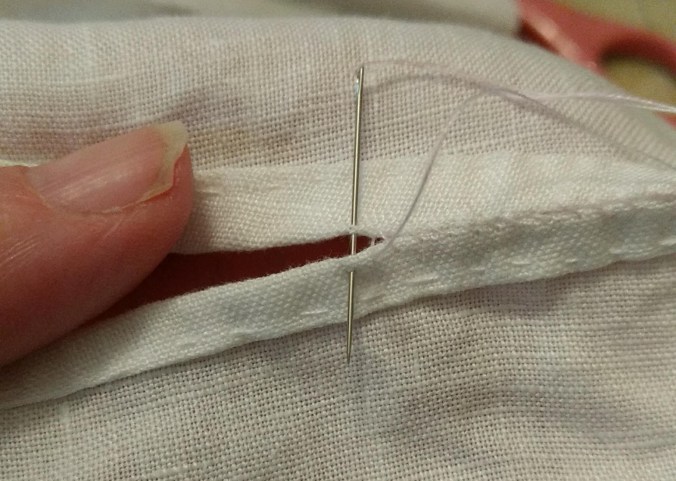
My preference is to hem all my pieces first. Not a rolled hem, nothing that exciting (yes, I know they are easy once you get going, but they are not easy in a moving vehicle, or in the dark.). Just take your raw edge, fold twice to hide the raw edge, running stitch to keep it there. Done. Do that around all the edges of everything. (I leave off the bottom hem, cause you’ll want to cut that off to length at the end.)

img_20190711_072045719

Yep, a hem.

Why do I prefer to hem all my pieces as pieces? Because I do almost all of my plain sewing somewhere else. In the car, at events, over lunch hour at work, in waiting rooms. I can pack a tiny sewing kit and a couple of pieces of a whole dress in a zippie bag and not have heaps of fabric trailing about with me when I inevitably get called 4 stitches in. I also get those edges that are wholly too fond of fraying tidied up right quick, before they’ve gained a few hundred km of travel time and been dropped in the car a dozen times and frayed even more. This makes for a moderately large seam allowance (rolled hem would be less, but I find it a bazillion times more of a pain), but basic running stitch is pretty meditative, and I can even still watch the scenery. It goes pretty quick, all things considered. Running stitch is not terribly strong, but this seam is just a hem. It is not structural, so that’s alright.

Once all of my tunic pieces are hemmed, I put them together using a whip stitch. Hold both sides together, and zip zip zip along. Once finished, this will open completely flat, if you don’t take giant chunks of hem in your whip. I literally take about a mm or so, and it lays quite nicely. This is a visible seam. There is no escaping that you can go ‘yep, there’s stitches’, but that’s an aesthetic that I appreciate, so this isn’t a draw back for me. If you want it to look like it all holds together with magic and starshine, this is not a tactic for you.

Finally, finish off the neckline, cuff and bottom hem as makes you happy. (I cut them to size, and do that same boring fold, fold, running stitch again.) Ta dah! Tunic!

Some drawbacks.. this requires 3 passes for every seam. (Both sides to be hemmed, and then a pass of whip stitch). Sewing the seam and then finishing that raw edge is only 2 passes, but I find my finishing isn’t as neat. If you mismeasure a piece, it’s a pain to take it out. It is, to be fair, less of a pain, as the whole thing is pretty modular, but it’s a pain. Possibly just the pain of yanking out a bazillion tiny stitches that you just put in by hand. Grrrr. Fortunately, you spend so much time up close with it, that the realization of ‘heeeey.. wait a minute’ has plenty of time to form before you’ve done too much, so you screw up somewhat more slowly.

So that’s today’s plain sewing, and all the tunics and underdresses for Pennsic. What’s your favourite garment assembly handsewing techniques?

Alchemy 201: Saponification

The next class in my Alchemy series debuted last weekend. The numbers are purely about topic.. the 100 series are dye, the 200 series are soap. I haven’t decided what (if) the 300 series might be. Suggestions welcome. (I mean you can tell me that it’s a terrible idea too if you want. XD)

The class went well, over all. It had normal first class jitters. Where you stumble over those quips that sounded so clever when you were preparing, or can’t remember exactly where in the notes you wrote that detail. Students were generally engaged, asked good questions, although it was rather less rambunctious than my last class. I need to work a bit on the notes to include a bit more overview, and manage expectations a bit. This isn’t a how to class, and these notes are not going to give you instructions on how to make soap (nor did the mordant class teach how to mordant yarn for that matter). And of course, I had grand plans of taking a class selfie, and then totally forgot. Whoops.

I’ve added my class notes to my documentation page, although be aware that they are going to get an update soonish (Before Pennsic, eep!)

I did go into this one feeling a lot more confident about the subject. Saponification is a really interesting reaction and is very well researched and understood. There’s a lot more definite answers about what’s going on in there than with mordants. It’s also a fairly controlled thing. These items go in, this happens, this stuff comes out, everyone shouts hurrah and goes home.

The next step is to take a deep breath, gather up my 20 seconds of courage, and offer to teach it at Pennsic. Teaching at Pennsic is something that’s always intimidated me (no, I have no real clue why.. possibly I just trust the Ealdormere A&S community not to be a jerk to my face.), but that’s ridiculous, and at some point I am going to have to put on the big kid pants and do it. They won’t bite, and if they do.. well after a consolation drink or two (mmm. Slushies), I’ll have great stories to tell. Having missed the book deadline by.. well.. a lot, there’s also the distinct possibility that I will sit by myself in a classroom for an hour and that’ll be that. (Weirdly, I have no such fear of teaching at Known World events. Apparently I trust string folks too. Hunh. Brains are terribly odd.)

Pennsic prep (and panic) are in full swing! Packing, classes and garb, oh my!

Book Review: Northern Archaeological Textiles NESAT VII

I’ve been gorging lately on library books, many conjured up from the far reaches of the province (and beyond!) thanks to the University Interlibrary Loan system. While I have them for an all too short period of time, I thought I’d highlight some of them.

img_20190604_181216614

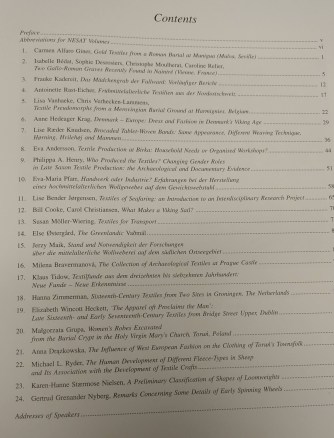
This one in particular has been coming up in the references of so very many papers I read, and I finally tracked down a copy. It’s the proceedings from the North-European Symposium for Archaeological Textiles (NESAT) held in Edinburgh in May of 1999. Edited by Frances Pritchard and John Peter Wild, published by Oxbow Books in 2005. (ISBN: 1 84217 162 3)

It is comprised of 24 short papers that were presented at the symposium. Most are in English, but not all. (5 are in German. I think. Looks like German? My language skills suck.) They range from a discussion about brocaded tablet woven bands, to the Textiles of Seafaring, to a preliminary classification of loom weights and a look at gender roles in textile production during the late Saxon period. This is not a how to book, this is a book of academically rigorous papers, full of solid bibliographies and references, and light on the pretty pictures.

img_20190628_142106266

Personally, I’ve been appreciating the article on loom weights (A Preliminary Classification of Shapes of Loomweights by Karen-Hanne Staermose Nielsen) and an updated article about the evolution of sheep fleeces by the major name in fleece history. (The Human Development of Different Fleece-Types in Sheep and Its Association with the Development of Textile Crafts by Michael L Ryder).

I have to say, even just flipping through it again to write this review, I’ve settled in to re-read a few articles, and continued to enjoy them. They are strongly skewed towards early period, Roman, Saxon, Viking Age, there’s only a couple touching on sixteenth century textiles.

This is, to me, a book that is handy to have library access to, but it is not a must own for everyone. I would appreciate having it, but I’m a bit of a research geek, and having it to hand to reference would be super handy. There’s good reason I see it cited in so many papers, there’s a lot of solid information in here for textile geeks. It will not help you figure out how to weave, nor provide suggestions on why your tunic doesn’t look like the picture. It will give you reason to say ‘ah, I was aspiring to higher authenticity, and I aimed my thread to be this size, because of this find.’. For some people, myself included, that’s valuable, but you may not be it’s target audience, and that’s fine.

I appreciate having access to it, and I wish I could have easier access to it (local library rather than ILL), so thumbs up from me!


UFO sightings!

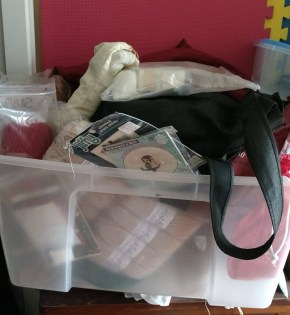
No, not flying objects (although Lake Huron did eat the frisbee on the weekend, whoops), but UnFinished Objects. Those projects that get started, often in a class, and then after a little or a lot of work on them, get put aside. Sometimes because you are wholly sick of them, sometimes because the next step is challenging and intimidating. Sometimes because you arsed it up and now it needs to sit in time out for an indeterminate amount of time to think about its wrongs. However it ends up there, it gets stuck in the UFO bin.

img_20190604_081054428

Literally an overflowing bin.

A few folks decided it was time to face the bin, and a few more of us jumped on that bandwagon. No competition, and no judgement if things go awry, just support for facing old projects that either need to be finished, or passed on to someone else (or the bin. Some projects never emerge from the time out corner.) A great many of my projects in the UFO bin ended up there  because I took six months off from knitting and needlework, and even still shouldn’t do /that/ much at any one given time. I haven’t included any of the ‘wanna do!’ projects in my UFO list, although my warp weighted loom project is rapidly becoming a UFO, which might encourage me to work on it again. So many projects, so little time and energy. The story of everyone’s life.

So of course, June’s UFO projects were mostly knitting and sewing. Because /that/ was a good idea. </sarcasm> There’s spinning in there too! Forgive the modern knitting, the bin is more than half modern projects, so UFO posts are not going to wholly period crafts.

Side comment.. I’ve just walked into something I routinely tsk at others about when talking A&S. There’s nothing wrong with modern projects, and even more so when it’s a modern project of a period skill. You are still shoving XP into that skill! My knitting skill is still improving even though it’s a wholly modern sock, and that skill increase will translate beautifully when I next do a period knitting piece. Sewing myself a skirt to wear to work absolutely helps my confidence in using the sewing machine for my next piece of garb. Not every project you do needs to be pentathlon suitable. (Excuse me while I repeat that a few more times just to remind myself.)

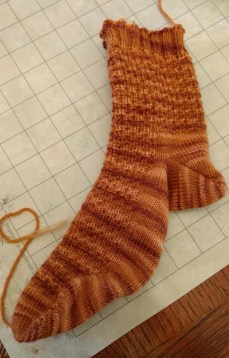
June had modest goals for UFO progress. Turn the heel of the sock in progress, and get all the pieces of an under-tunic hemmed by hand. I did not consider, when making June’s goals, the reality of a 4 day gaming convention in the middle of June. So the reality looks like a tunic hemmed and assembled and just needing final finishing, and a finished sock. (Sorry, no tunic photos. Think of a white linen t-tunic. There ya go. Looks like that.) And then my arms had comments to make about spending 4 solid days doing things that tick off my tendonitis. Second sock goes back into the bin (I am wholly and utterly sick of the pattern anyhow, it needs a time out) and finishing of that tunic is going to have to wait for July.

img_20190623_094624109

It’s a sock! It even fits!

UFO bonus round.. spinning! The Corriedale is almost done (and terrible. I will be glad to see the arse end of it. So nubby and fuzzy and grrargh), and the silk is eternal, because I never work on it. It is on tap as one of July’s UFO projects. I want to knit with that silk, dammit! (Yes, I have 1000 knitting projects in queue, but somehow this one is urgent. It’s really not, but forgive me my delusions about project queues).

img_20190624_122232797

Wool and silk.

So what’s your UFOs? Or are you a mythical crafts type who finishes what you start?

Black Sope

This was part of the plan for Kingdom A&S in March. I had acquired the wood ashes (surprisingly challenging when one lives in the heart of suburbia without a fireplace), I’d even managed to drip my lye by the time KA&S rolled around in March.

img_20190605_201145188

Homemade lye

Let me back up a step to talk about lye. That’s the hazardous part of soap making that scares a great many people off. (Yes, it will burn you. Treat it with the respect it deserves. Gloves are smart, don’t breathe the fumes, but equally don’t freak out and run screaming. You got this.) Lye is the basic (alkaline) part that makes saponification go. Saponification, in a super quick nutshell, is the chemical reaction that happens when fats and bases get together and produce soap (and some other stuff). There will be a much bigger post about saponification after I finish writing that class about it that I’m teaching at Trillium Wars. <counts days, has a quiet erk. Right!>

Modernly, you go to the hardware store, look in the plumbing section and bring yourself home a bottle of lye crystals. (Or you go to Amazon, cause Amazon.). That’s Sodium Hydroxide, and it’s pretty stable in crystal form. (Wear gloves. Don’t sniff deeply, don’t lick it.) It makes the lovely firm bars of soap that we all know and love. It’s also challenging to get in a medieval context. Not impossible, just challenging. Period lye was Potassium hydroxide generally, and much, much easier to get your hands on. Hardwood ashes + water = potassium hydroxide. Potassium hydroxide makes a soft soap, not quite liquid soap, but goopy that never really sets up hard. There wasn’t much in the way of pH meters hanging about, so the strength of your lye was determined by how well it floated an egg. (Interestingly, the strength of brine.. also determined by egg floating. Eggs are darn useful things, and tasty too! Do not eat the egg you floated in lye. Just saying.)

Right! So I dripped my (distilled) water through the hardwood ash and came out with lye. I even diluted it to the required strength for a mild soap. (My soap making directions all came from Mistress Elska who knows more about period soap than anyone else I know. Go read all of her awesome. She’s super cool.) As much lye above the egg as below it. Perfect.

img_20190605_201909263

pH testing magic

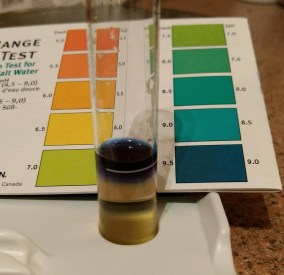
And then life happened. And we all know how that goes, and suddenly it was June and I wanted period soap to try washing some fleece with. Ha! Incentive to get this cooked up. A quick pH test showed my diluted lye was at least pH 9 (the indicator I used only goes to 9 and my pH meter was hideously uncalibrated and I was out of calibration solutions. The woe of the modern alchemist who wasn’t planning ahead.), so not wholly dead yet, but I had some concerns. Liquid lye isn’t the most stable of things, it’ll degrade pretty good. The recipe called for 3 parts by weight lye to 1 part by weight fat. So my 927g of lye was going to get 309g of fat. I had some lard I rendered that needed using up, and then the other half of my fat was beef tallow.

img_20190605_201138769

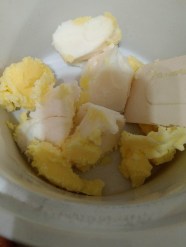
Pork lard and beef tallow

Melt the fat, pour in the lye, give it a darn good whirl with the stick blender (yes, I could have done it by hand, but it was late) and let it wait overnight. Another good stir the next day and then the cooking started. I work in a crockpot, and remember that life thing that got in the way of using the lye in the first place? Right. It kept popping up for the cooking of the soap. It was getting cooked for a couple hours at a kick, and then I’d have to leave, so I’d turn it off again, and come back to it much later and start again. So it went, and then it was the night before I wanted it and it was STILL liquid and not soap. I was headed to bed, it looked like it was JUST barely starting to come together, and I asked my video game playing spouse to keep an eye on it, stir it now and then and turn it off when it looked like thick pudding, or vaseline.

I got up the next morning to a dark brown pot of charred goo. (Yes, he forgot and yes he apologized. Such is life, it isn’t the end of the world.)  I came >< close to just chucking it, but decided at the last moment to toss it in a plastic pot and bring it along to the event. At the very least, we could have a good laugh about my charcoal riddled goop. When I was washing out the crockpot, I noticed that it.. acted like soap. It melted like soap, it felt like soap between my fingers. Not classic soap, soap with the texture of playdoh and random crunchy bits, but certainly soap. Well, hunh.

img_20190609_111146600

Mind the crunchy bits.

Arrive to a group of awesome people and a swack of dirty fleece and we all have a snicker of the charred goop, and decide to try it. I mean, we’ve plenty of fleece to play with, a bit of ‘well that didn’t work’ isn’t going to be the worst. While I’d been off at other obligations, they’d already tried a laundry bar soap, some laundry detergent and just water to varying degrees of clean. So into the warmish water a clump of my goop goes, with a lot of swishing about to get it to dissolve. But it DOES dissolve! (Mostly. It really does need encouragement, and well.. one needs to pick out the charcoal bits, those don’t dissolve. <ahem>)

In goes some wool, and it gets a good swish about and hotting up and after a little while, a trip through the salad spinner. (Best. Thing. Ever for pre-drying your wool. Seriously. I needs me one.) And it’s white! It’s clean! Pretty and clean! Our tepid water was doing nothing to the lanolin, but the soap of epic fail did a darn fair job at washing the dirt out, I was most impressed.

<I forgot to take pictures of the wool. Picture pretty wool, all white and clean before carding or combing>

I will try and make it again with freshly dripped lye, and a lack of forgetting it to burn, and see what we get, but wowee, even with everything against it.. we got soap! Alchemy ftw!