Community

Community is everywhere. It’s a notion that can come from physical proximity.. your neighbourhood, your canton, or shire or barony. It can come from shared interest.. the birding community, the fighting community, the A&S community. It can be in person, or from afar over social media (or post cards, or magazines, or discord channels.) All humans, even the most ‘grrr, I hate humans’ sort of introvert crave community on some level. We are social beasts, even if it’s just someone to hate humans with. You will never love everyone in your community, we’re all irritatingly fallible humans, many with somewhat questionable social skills, but that’s the nature of the beast, and ideally when we all put on our grownup pants, we manage to at least get along. (This is not a post about abusive or toxic members of the community, that’s a whole different conversation.)

Some communities come together very naturally in the SCA context. Fighters and fencers need each other to practice. Pell work is all fine and good, but you don’t get very far without other people. Missile weapon folks, they have a lot more opportunity to work alone, but not very many people have the luxury of enough space (or legality) to be able to throw axes or shoot arrows in their backyard, so by and large, they gather where the targets are.

A&S can, and almost often is, done wholly alone, hidden away at home. Workshops and floor looms don’t travel well. Detailed fussy work, be it with brush and pigments or needle and thread require good light, concentration and a lack of the table getting knocked accidentally. Some folks can, and do, bring bits and pieces to work on with others. Craft days, or at events, but 90% of it happens at home. Often just with your own thoughts of ‘well this is crap’, and ‘wtf? That is totally not what the instructions said would happen’. We are, by and large, solitary creatures.. and often with the social skills that come from being solitary creatures. (I get excited and overshare and forget that shutting the heck up is totally a thing I can do. I’m not /good/ at it, but I can do it. Please do remind me as necessary. XD)

And then we all come together… at a display, or competition or class filled weekend, University, schola.. however one wishes to phrase it. Walking into one of those in full swing is like hitting a wall of creative energy.. edged with nerves as often as not. Even the most gentle of judging is still challenging for entrants and judges alike, and if it’s for something big.. war points, championships, pentathlons.. then there’s even more nerves. New teachers (and some experienced teachers) do not teach because it comes naturally, but because they love to share, and are utterly faking it when they look calm and relaxed in front of a group of people.

Probably the best example of this is walking into the A&S display at Pennsic. (Middle weekend, Sunday afternoon! Come visit!) Artisans from everywhere have brought what they’ve been working on, and most of them are there to chat about their work. Some of it is mind blowing in terms of skill and research and depth. Some of it is a tentative beginner foray into something, and you look at the artisan and see a mix of pride at their new skill and a hint of terror that someone is going to be that ‘mean judge of legend’ and harsh on their beginner work. There’s people asking questions and explaining what they’ve done, yet again. There’s the display you can barely get near and the one that most people barely glance at, either because it’s not colourful, or they’re the last on the row.

And I love it. I love every last bit of it. I love the ones bringing the lumpy spinning that they fought tooth and nail to get, and I love the ones who have giant display boards that are the culmination of a decade of research into one specific thing. I love the ones that I know nothing about, but get to watch someone light up with the same passion towards their craft as I do about bits of string. I love chatting with people, I love doing A&S consults when the EK folks will have me. (Have questions about how to improve? Be it your display, your work, your documentation, or how to quell some of the terror of competition.. sign up for a consult! Totally voluntary, it’s usually next to the registration table.)

Phew, I’m not sure where I was going with this, beyond how much I appreciate the A&S community. It’s not perfect, we’ve got challenges and toxic trolls too, but big picture, thank you. ❤

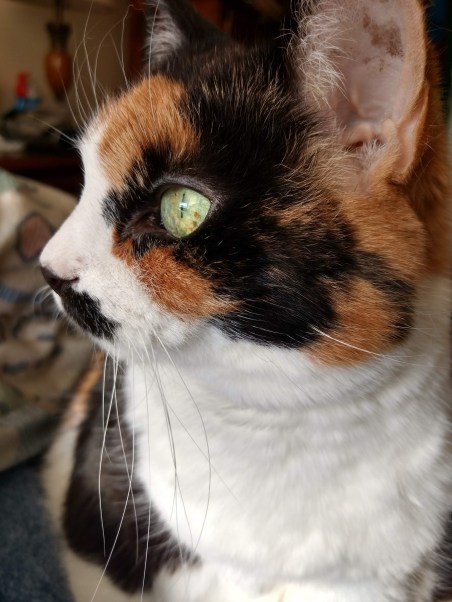
And if you got this far, here’s my elderly calico Dalla in a sunbeam.
img_20190318_165114013_hdr

To ply, or not two ply

Aww c’mon, I couldn’t resist! (Yes, I should have resisted, I know, I know.)

Another post about spinning, you’d even think that’s what I’ve been doing the most of lately, and you’d be absolutely correct. I got the messy miserable nubbly fuzzy batch of corriedale spun up and looked at the lumpy thick mess and decided on the spot that it was never going to be good weaving yarn, so I should just suck it up and ply it.

I usually leave my spinning in singles, such that I can then make the choice when I go to use it as to if I want to ply it or not. Knitting and embroidery prefer plied fibre, I think naalbinding agrees. It’s got more strength against abrasion, more resilience against being untwisted, and some of that extra energy has been mitigated. (I also strongly dislike plying, its another argument for leaving it as singles.)

Plying, for those who have only ever considered it in relation to toilet paper.. is much the same notion as TP, really. Singles yarn uses a single strand of spun yarn. It is spun either S or Z (counter clockwise, or clockwise) and everything has the same twist. (Unless your piece makes a deliberate choice to use S spun for part and Z spun for another part, but that’s a different conversation.) Two ply yarn takes 2 singles (spun the same direction) and then spins them together in the other direction. (2 Z singles held together and twisted together S is my usual.). You can do 3 or more plies, skies the limit really, or your sanity.

So singles have extra energy? What extra energy? When you release the tension on freshly spun wool, it doubles back on itself, making little curlicues of yarn with all the extra twist in the yarn, or what most knitters would call extra energy. (And providing you with a sneak peak of what your 2 ply yarn is going to look like.) You can tame it to some degree by leaving the wool wound up in a spool, or lightly weighted and then either steamed and left to dry, or just wait it out. It relaxes, doesn’t curl up on itself anymore. Until you get it wet (or steamy) and ka-sproing! It wants to curl back up again, and depending on what that yarn is doing, it may or may not be able to skew things.

img_20190603_105806929

Ka-sproing! Singles!

Knitting is a series of interconnected loops, and it has a lot of freedom to wriggle within the stitches. Knitting with singles tends to skew fairly dramatically, which can be fine if that’s the look you want, but most people prefer nice evenly straight knit stitches, and therefore use plied yarn. Embroidery tends to be well pinned down, but that abrasion factor is huge going through cloth, and singles tend to unspin just enough to want to disintegrate. There’s also the reality that plying gives another chance for thread that is somewhat uneven to even itself out, where thin patches line up with thicker spots. Sometimes you lose, and thick spots line up with thick spots, but overall, it tends to even out fairly well. Odds are in your favour, and all of that.

Weaving, however, puts the threads into a rather rigid structure, and forces them to stay there. The singles don’t really get to /go/ anywhere, re-energized or not, and so a lot of weaving is done with single ply yarn. It changes little, due to the structure already in place. It might take longer to weave, but less time than a spinner having to do more than twice the work. (For 50 metres of 2 ply, a spinner would need to spin 100 m of yarn, and then twist that 50 metres a /third/ time.. so 150 m of work, for 50 m of yarn. Boooooo. For a 3 ply yarn, they’d have to spin 150 metres, and the ply 50m, so 200 m work for 50m of yarn. You get the idea.)

img_20190603_130259699

Corriedale messy 2 ply

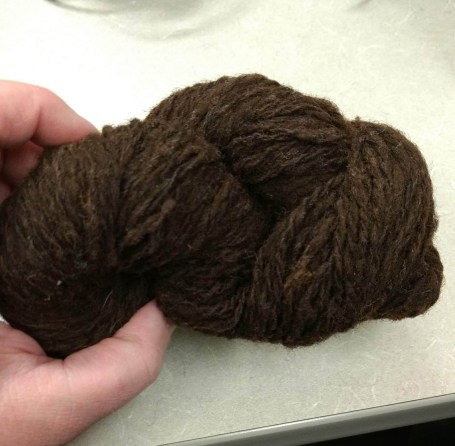
So, because of all of the fuzzy, and the thick and thin, and generally enh of this bat of corriedale, what little I had of the dark brown got plied up into a 2 ply yarn. There’s not much of it, and it’s going to go sit in stash ’til I think of something that wants not terribly soft yarn, but I have faith that something will come up eventually.

Spin me right round

I bet more blog posts about spinning have quoted that song than anything else in the world, and I just acquired another check mark on a right of passage or something. But in any case! Spinning! That’s what I’ve been working on of late. (Not <coughahem> the flax so much, cause wow, that is not my happy place yet. Apparently you actually have to practice to get better, how irritating.)

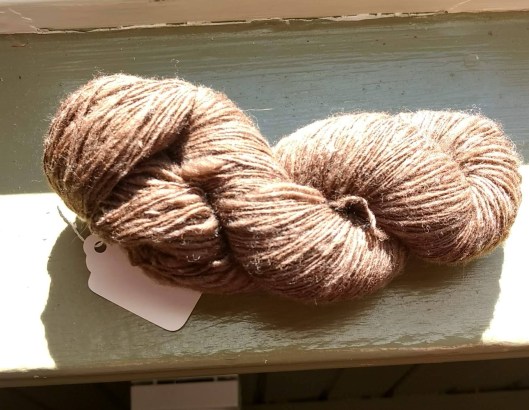
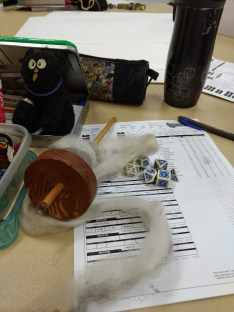
I’ve been continuing my wander through the stash, some of which is a few years old, some of which is ‘I think I’ve moved this twice, and we’ve been at the ‘new house’ for 8 and a half years’ sort of elderly. The colourful mystery wool yarn I was working on in the status update at the beginning of the month.. done. The purple/charcoal alpaca that came next.. done. The dark brown Cormo that came after that.. done. Now I’ve got some spectacularly terrible Corriedale on the spindle, dark brown first, but I have an equal amount of white. All of those have averaged between 25  – 50 grams, so none of them are especially long projects to get them spun up. I’ve been leaving them as singles, to wait and decide what they want to be when they grow up.

img_20190508_075228759

Colourful mystery wool!

That being said, the differences in spinning so many different things in quick succession has been fascinating. Basically after you wash the fleece you need to take the wool and make it ready for spinning. There are two main kinds of fibre preparation. (Spinning from locks of wool is a third, that’s a really light processing to just open them up, but I’m not covering it here.. I’ve never actually tried it. Another thing for the list.)

img_20190508_141050872

Purple alpaca

I’m working in big generalities here, there’s exceptions everywhere.. but carded wool tends to have its fibres all willy nilly and puffy full of air, and combed wool has it’s fibres all lined up in perfectly neat rows. Everything in my stash was commercially prepared for modern spinners, which means my fibre tends to not be a perfect example of either, but lean strongly one way or another. That carded wool all willy nilly and puffy? It is supposed to be spun with a long draw and makes woolen yarn, which is all bouncy and full of air and vaguely fuzzy. Combed wool that’s all straight and lined up? It is spun with short draw and makes worsted yarn (which is not the same as worsted weight yarn, because language is cruel.) that’s all firm and solid and has awesome stitch definition and makes great warp.

img_20190527_094952996_hdr

Cormo in a sunbeam

My colourful mystery fleece, the lincoln and the alpaca.. all worsted. The Cormo and Corriedale.. woolen. Oh the bounce! Oh the fuzzies! Oh I am such a worsted spinner! Long draw and I have a frustrating relationship, but we’re working on it. I’m also trying to let go the notions of perfection in these woolen yarns, there’ll be fuzzy bits, and kinda extra bits and please stop overtwisting the snot out of it! (That’s not panning out for me so much.)

img_20190527_112051727_hdr

Messy Corriedale batt

Still, it is nice to move a few things from the overflowing fleece bins to the overflowing yarn bins. Hrm. Perhaps not quite the stash busting I was hoping for!

Alchemy 101: A new class

The title phrased that way sounds like I’ve wandered off into the Star Wars universe, which is not wholly wrong for this reign, but I digress.

I had an inspiration after an advanced natural dye class down at Gulf Wars in 2018 that I’d love to bring something like that up to Ealdormere. Time passes, distractions happen and then I end up on a ‘no string’ diet and go off to find other things to keep me busy, mostly beer and soap, two things I’ve long wanted to experiment with. Then the thinking happens. <insert dramatic key change here>

Beer and soap are basically alchemy. Certainly they would have been in period, even if not defined as such. Substances go in, ritual happens (slow or not), and then completely different substances come out. Dye is much the same way. White goes into a ritually prepared vat of disgusting, other colours come out that don’t wash out (much). Ritual here being used in a non-religious sense.. a cooking recipe is a ritual.. something you do by rote, the same every time. (Okay.. apparently some people cook like that, I don’t, but the theory is sound.. just work with me on that comparison.)

The next thought came: ‘I know a lot of folks doing this who don’t wholly understand the science behind it. The SCA attracts a lot of folks from the arts (woot!) but if they took high school chemistry, it was a) a class they detested and got out of asap, and b) was <coughmumble> number of years ago.’ The thinking continued into ‘Hey, I have a chemistry background <blows the heavy layer of dust off that degree>, I could translate out of chemistry into normal and give people some clue what’s happening in there’.

And so ‘Alchemy 101: What’s really happening in your dye pot?’ class was born. It only covers mordants. Class is designed to be only an hour long, lest the whole pack of us get to eye crossed overwhelmed with big words and thoughts. It has its inaugural teaching at FooL this past weekend, and while I was fully prepared to sit by myself for an hour when no one turned up.. class was full! I ran out of handouts (I had only printed 5, I thought that was plenty optimistic!) It seemed to go well, there’s a few spots I want to do more clarification and of course the first time running any class is a bit of a scattered mess of getting off topic and reordering the ideas to more closely follow class questions.

I am pleased. We’ll see what Alchemy 102 looks like (more dye? care and feeding of yeastie beasties? saponification? So many options!), and of course..comments and suggestions on Alchemy 101 are always welcom.

Flax vs Spindle, Round one

So the next obvious portable part of the Big Stupid Project(tm) (BSP) is to get the flax spun up for the strap. I’m sure there’s many who would say that wood carving is totally portable, but not gonna lie, I’m still working up the nerve to figure out what to do with wood, so spinning. I can spin.

It has been a very long time since I spun flax. Long enough that those same brain weasels that are having a heyday with the notion of wood carving made a stab at freaking out about the flax. Which is, by the by, patently ridiculous. I’ve spun flax before, it wasn’t amazing, but it was possible, and that was easily 15 or more years ago, and I’m a helluva better spinner now!

So in a bid to ignore the rest of my to-do list (productive procrastination ftw!), I poured some water into a dish, grabbed flax and spindle and off we went.

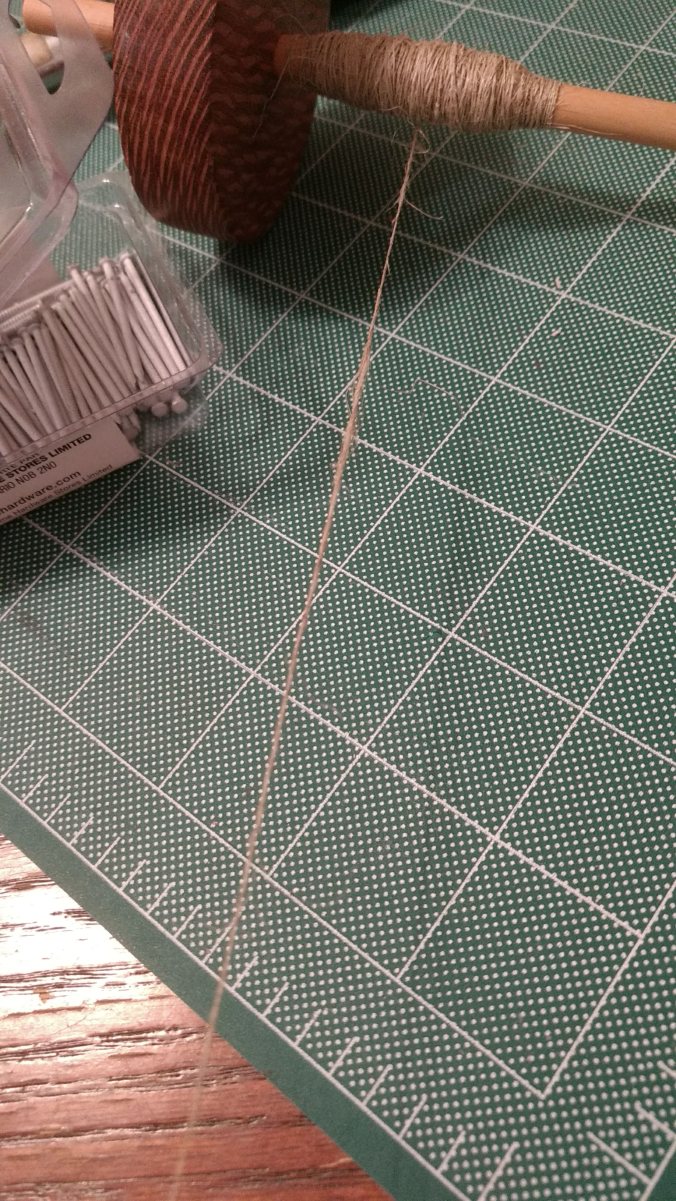
Flax can be spun either wet or dry, although wet spun flax is generally considered to be smoother and stronger. We’re not talking soggy here, but wet fingers smoothing over the flax and little dribbles end up everywhere. There is also popular assumption that flax must be spun S-twist (it’s Traditional! For Reasons! Because the flax plant likes to twist around things clockwise!), but as the archeological record shows that no one told the Norse that, they spun it Z. My habits are to spin Z and ply S, and that’s what the flax is getting too.


My flax is exceptionally dry and brittle, it’s been hanging out in stash for I have no clue how long, and it’s still closer to winter humidity than summer humidity around here. Flax staple length can be measured in feet rather than a small handful of inches. It has all the quirks of long staple spinning, all the irritation of silk’s desire to catch on everything, all the obnoxious of unending fuzzies like mohair, all the lack of felting like cotton (Why do you catch on everything EXCEPT when I’m trying to connect a broken spot!?), and all the stubborn cussedness of linen. (That last one.. not exactly surprising).

img_20190506_220340354

I got thread!

In an effort to try and tame the flax a bit, I poured some water in the bottom of a plastic bucket, stuck the flax in a tupperware container and floated the tupperware in the bucket, the lid pinned down by a C-clamp. (Feel free to envy my high class fibre tools.  Between toy wheel spindles, pvc pipe niddy noddies and various buckets, boxes and dowels, a fully functional spinning set up is under 10 bucks and a little time with a saw.) I haven’t had time to try spinning my humidified flax yet, but just the feel of it is so much nicer, for that alone, it’s totally worth the bucket trouble. Mother nature seems to be insistent on trying to keep my flax more damp for me by providing unendingly rainy weather, but honestly.. sunny and dry any time now.. I am happy with the bucket tactic!

img_20190513_102306042

Flax in its tupperware.

The next task is to try and spin a little less fuzzy and a bit thicker. The prospect of weaving with sewing thread is one that I’m willing to do, but not excited to do. Hopefully practice makes for more perfect, or even just less sucktastic.

The Warp Weighted Loom: A book review

While working on my BSP(tm), I went digging for resources on warp weighted looms. A number of posts came up, and when chatting with some out of kingdom weaving friends of mine, this one book got mentioned as being a really great resource. Long story short, I managed to get a hold of a copy via University InterLibrary Loan (Thank you Princeton for buying cool textile books.) to be able to have a wee look see before I ordered from Norway.

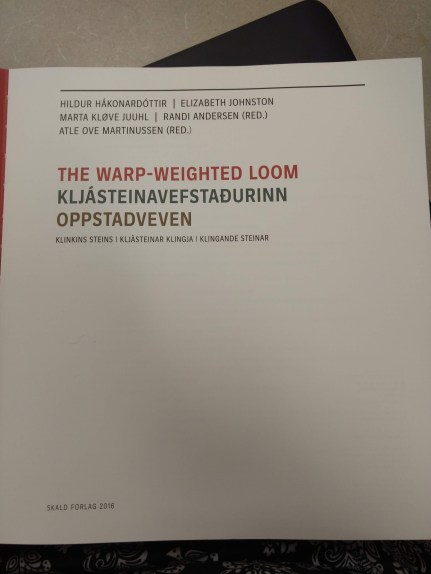
The Warp-Weighted Loom I Oppstadveven I Kljásteinavefstaður by Hildur Hákonardóttir, Elizabeth Johnston and Marta Kløve Juuhl 

It’s a hefty book, at about 300 pages, and while I didn’t stick it on the scale, hauling it around in my backpack, I absolutely knew it was there. It has a solid cardboard cover, heavy pages within, and is bound such that it will lie utterly flat and stay open. It is a very pretty book.

img_20190412_154418018

The book itself is divided into three sections. The first section is a look at the history of warp weighted looms in three different locations; Iceland, Shetland, and Norway. The second section was a practical ‘how to’ for making and weaving on a warp weighted loom and the third section was a series of articles, essays and reports relevant to warp weighted looms.

The history of the loom was really engaging and interesting. They took a very personal tack on how the loom fit into the culture and society in each place. The inclusion of Shetland is unusual from what I can read, and I really appreciated it. They went as far back as they could find information for, solidly into our early period and discussed the loom in each of those areas up to when it was replaced, often in the 19th century sometime.

The practical section included clear photographs next to each description of what to do next. This section was written in English, Icelandic and Norwegian. There was both how to start with a tablet band and without, and how to thread heddles both for tabby and twill. While I haven’t yet tested the directions myself, reading them over made the experience seem accessible and possible. I look forward to trying them out soon (and a friend swears by those directions to get her heddles knitted on).

The final section was the one I wasn’t expecting. Bits and pieces of this and that.. from the book’s website, you can see the titles of this articles in this section. More history, an article on grave finds. Experimental archeology. Traditional bed covers, finishing cloth in the sea, traditional crafts in modern society. They were fascinating little tidbits. Short, about a magazine article in length, but thoughtful and well written and left me wanting to read more, or experiment.

I got the book via ILL to see if it was worth the money and hassle of importing it from Norway. It’s a small publisher, they sell direct.. there’s no Amazon machine to make international currency and shipping convenient, and I can say that this book has been added to the shortlist of book buying, once I save up my pennies. (Small press textile books are never the cheapie ones, drat it!) I was really impressed and I’m looking forward to adding it to my textile library.

Project Status Report

It feels appropriate, on the first of the SCA year (Welcome to AS LIV!) to have a moment of ‘what’s where’ and ‘you’re doing what!?’.

I eternally have lots of stuff on the go. Little stuff, big stuff, A&S stuff, modern stuff. I learned (the hard way) that too much focus makes me crazy, and drives my unreasonably fussy joints nuts. It takes me longer to get things done, but it suits my SQUIRREL! brain, and changing what I’m working on day to day, or even hour to hour keeps the stress injuries down. Even if I failed on that hardcore in the fall, and am still paying for it. (It’s healing! Slowly! I’ve never been so grateful to do a few minutes of mending in my life. Gratitude for mending will not happen again, I enjoyed it while it was there.)

That being said, there are a few projects that are in the current main rotation, and so I figured I’d share what’s on the worktable and in the project bag.

The Big Stupid Project: Ahh, scope creep is at me again. This is going to be, someday a Hedeby bag. (The Norse bag with the wooden handles, for those wondering what I’m on about). The warp weighted loom has been borrowed! The spinning for the wool has been completed! Next up is a sample warp on the loom to have some sense of what I’m doing, spinning the flax for the strap, and learning about warp sizing. There are many many steps after those ones, but let’s focus on the immediate ones, lest I fall over in a heap from my own crazy.

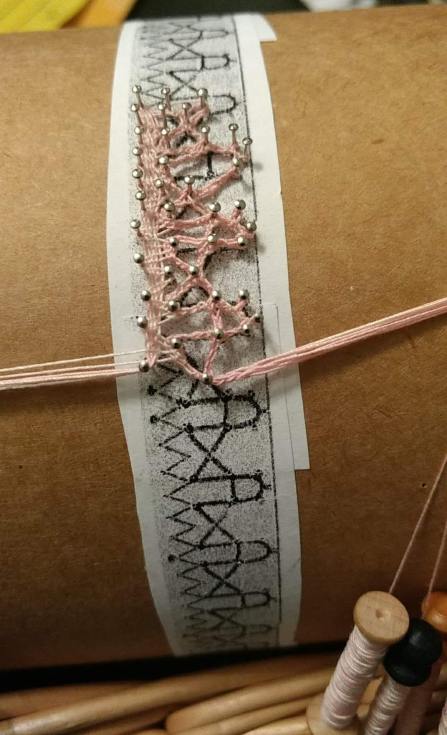
Pink Practice Lace: This bit of lace had exactly two purposes. To remind my hands that we still knew how to make bobbin lace, and to use up some pink tatting cotton that has been in my stash forever (and is probably easily 60 yrs old. Much of my cotton stash is vintage, that’s a whole conversation in an of itself. It’s a good thing I like stripes.) The plan was to just go ’til I ran out of cotton, there’s not THAT much on a tiny ball of tatting cotton, right? Well apparently I have an artifact of endless cotton or something, because while my bobbins are getting low, they aren’t out yet, and I’m 16″ + worth of lace done. And there’s more on the ball. So while my picots are still a dog’s breakfast, there should be at least 20″ in this (maybe more if my artifact theory pans out) and it’s been promised to a friend whose eyes lit up at the pink.


Random spinning: Now that the easy spinning for the BSP is over, and I still can’t reliably knit or use a needle (5 whole minutes! A /day/. But progress!) I still need something portable and moderately not obtrusive to work on at lunch hour at work, or when I’m sitting watching court, or just to keep the hands busy. I have some silk I’ve been spinning forever (It has a Plan!), but I also have been digging out the oddballs of dyed fleece I’ve accumulated over the years. Awesome dye jobs, totally not SCA period, but colourful and fun, generally not much more than 50g each. What I am going to do with not much colourful yarn? Excellent question. It’ll age in stash ’til needed or inspiration strikes.

Garb: I’ve said it before, and I’ll say it a few thousand more times. Garb is not my A&S. I can do it, sometimes its even not terrible when I’m done, but I drag my feet and grumble every moment of it. I do, however, like having new clothes for the weekend wardrobe. That last bit usually outweighs the bit that comes before it. The fact that I can’t hand sew more than mending at the moment is not helping, as I rather enjoy hand sewing, but the machine and I mostly tolerate each other. (The serger and I are not currently on speaking terms. There was an Incident involving polar fleece, and we both felt it better for everyone involved if the serger just went and lived in my husband’s workspace. It’s for the best.) There’s a few pieces I want for the coming camp season (wool coat, underdresses, chemises, new kirtle etc), and while the coat is mostly done. (see the aforementioned heel dragging), the rest are at the ‘gosh, I should probably do that, but oh look, a loom!’ stage.

That hits the highlights of what I’m working on.. there’s always more little projects here and there, and I reserve the right to Oooh Shiney! off to a new one at any moment. What are you doing at the start of AS LIV?

Beer Experiments

When my arms decided that I was going to enjoy an extended and involuntary break from my usual string, I took up brewing. (The joke being that I had to drown my sorrows.. perhaps not wholly wrong.) The fact that brewer’s guilds (formal and informal guilds) from three kingdoms are terrible influences is a minor technical detail, and apparently I only have so much willpower. I dutifully followed the brew store’s beginner (ish) recipe for the first batch, had it turn out rather nice really. (Coffee stout, partial mash)

Then I went out on my own, because why on earth would I follow directions for brewing when I’m incapable of following recipes or patterns to the letter /either/. I moved to 1 gallon batches, because if its going to go all horribly wrong, it’s less whimper inducing to dump a single gallon down the sink than a giant 5 gallon batch, and well.. I might enjoy brewing beer, but I don’t actually drink very much beer (or any alcohol really). (Yes this means that you can get free beer from me at camping events. Newbie who doesnt’ follow directions brewer, you’ve been warned. Drink at your own risk, it’ll be worth the price you paid for it.) (PS. I want the bottles back.)

In any case. I spent the winter of no-knitting or sewing playing with yeastie beasties. A couple more quite successful brews (mostly following the instructions!).. and then I went out on limbs. The first experiment was a wort split 3 ways, with three different yeasts. I entered it in A&S, and you can go read my Beer and Bread documentation if you’d like. The TL;DR of it is that a bitterly cold winter, a damn cold back room made for pretty sad (aka low %) beer, although the sourdough starter works just fine to brew with. (My doctors appreciate me drinking a 2% beer though!) It’s tasty though (IMO), if overcarbonated (open over the sink or in a field, pour into a glass quick!) I do want to run that experiment again when my back room isn’t sitting at about 15C. Poor shivering yeasties.

This past weekend, I decided to go play in what the homebrew community calls SMaSH beers. Single Malt and Single Hops. I also decided to poke at small beer, which is the second run through of the grain. Forget sparging (washing the sugars out into the first batch), just make a whole other batch!

The technical details are 2 lb of Marris Otter, 12 g of East Kent Goldings and 50 g of Wilma the sourdough starter. I brew in a bag, cause convenience wins around here. Each was about a gallon batch, the small beer is a bit less, and I decided not to dilute it further by topping up with water. First run OG is 1.058 and the second run through the grain has an OG of 1.020. I was going to do a third run, but honestly if the second one is already down to 1.020, the third really is going to just be water at that point. It seemed overkill.

2019-04-22-07.14.24.jpg

I can’t imagine that even in my cool kitchen that the small beer is going to take that long to ferment, there’s just not enough sugar in there for the yeasties to need to work at it all that long!

I’ll let you know how it goes!

The Big Silly Project

This project is a study in scope creep.

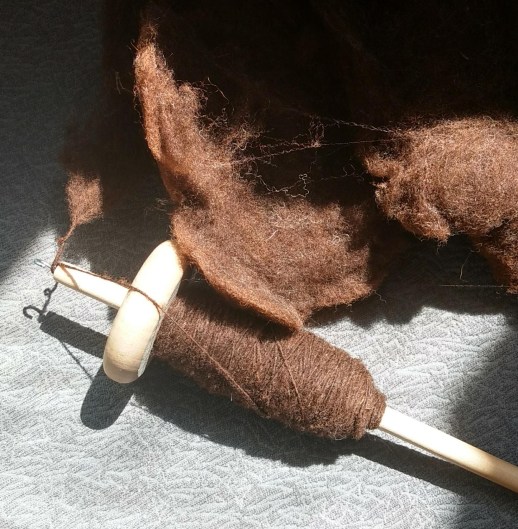
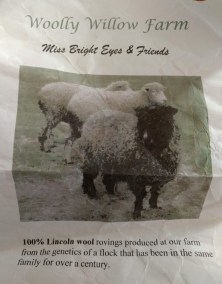
It started with ‘hey, I can’t knit atm, and I picked up some fleece a couple years ago that is early period pretty close.. I should spin it up’. Dig out spindle (A modern one that I’m fond of, nice mid weight, conveniently empty), dig up the bag of lincoln longwool, start spinning. I spin thin naturally, and this was all about just ‘hey, let’s do some spinning’.

img_20190417_110409837

As I’m spinning, I start thinking of what I might do with my freshly spun yarn. It’s not the softest in the world, which is fine, I don’t begrudge it that. So not really next to skin sort of projects. I only have about 120g, so there’s not a whole lot of it either, so this is not about to become outer garments either. I’ve always wanted to make myself one of those Hedeby bags with the wooden handles, that seems reasonable for this yarn. Alright, project decided. Spin, spin, spin.

img_20190405_191538184

Brain then starts chewing on the weaving part as I’m spinning, and that internal conversation sounds something like ‘well if I’m weaving an early period bag.. then I really should weave it on a warp weighted loom.’ Because the 4 looms that live in this house aren’t sufficient, I clearly need to acquire another and learn a whole new technique of weaving. Clearly. Start reading up on the making of warp weighted looms, and how to weave on them. Arrange to borrow one, acquire books (and articles and conversation with other artisans) to help the process. Spin, spin, spin.

More thoughts as I continue to spin.. the mottled grey of this fleece is just gorgeous, it’d be a crime to dye it and not just embrace the sheepy colours going on here. Thank you brain, for saving me one step worth of scope creep. Spin, spin, spin.

Brain continues to chew on the project, and there’s a thought that the strap for this bag really shouldn’t be wool, it should be linen. Wool stretches far too much, it’ll start at my hip and end at my ankles by the end of the day. Alright. Tablet weave up some linen for the strap. That’s easy enough. Spin, spin, spin.

img_20190409_130804995

But wait! Says my traitorous brain.. you’ve long wanted to give flax spinning another try. It’s been a good 15 or more years, and there’s flax just hanging out in the stash. Remember this was going to be a stash busting exercise? You should spin the linen for the strap. You’re spinning everything else, after all. Gee brain, that sounds like a fine idea. Look up some suggestions for flax spinning, chat with experts in flax spinning, find the flax in the stash and another free spindle. Spin, spin, spin.

And so, that’s the state of the Big Silly Project (BSP). The dye thoughts for the linen strap are just starting to creep in, and the documentation for this is going to be a novel. I’ll keep you informed. For now? Spin, spin, spin.

Preparation: The project before the project

I decided to get a little bobbin lace project (or two) together to remind my hands that I did still know how to make lace. (And to confirm that it doesn’t tick off the arm too badly. Mixed results there.) Cotton thread (no sense wasting the linen thread I’d misplaced and then ordered new on effectively a disposable project), try some new to me bobbins (and my two favourite pairs). Cut a failed project off the pillow. Awesome. I have bobbins, thread, pillow and pattern.

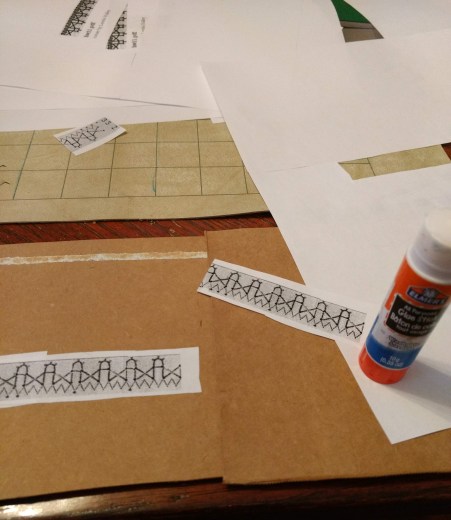
And then the preparation starts. This is the bit that actually takes significant time, just the same as in weaving. Measure thread and wind onto bobbins. Take a good guess at the size of pricking you’ll need for the thread you’ve chosen (or be fortunate and have your pattern tell you.). Piece it together, glue it to card (if you didn’t photocopy it straight onto card). NOW pre-prick all of your pin holes. Important for accuracy, and when digging around with a tiny pin under a windmill crossing, you appreciate just having to find the hole, rather than peering to try and decide where a hole should be. This could easily take hours, if not days depending on your project.

img_20190303_083934607

Weaving is just the same. Pick your warp and weft, pick a pattern. Measure your warp, tie it off carefully. Sley those heddles, thread that reed with hundreds of threads in a very precise order. Hours if not days of the least ergonomic work in the world. (Make it more ergonomic, your back and sanity will thank you.) Wind onto the back beam, tie it all off, grumble that tension is funky, untie and tie again.

All the while, you are impatient to get to the REAL project! Finally! Actually weaving! Actually making lace!

Except that all that bit before.. it WAS weaving. It WAS lacemaking. It’s as (or more) important than the later steps! I have no magic cure for the impatience. I try and be mindful about enjoying the feel of the thread, of getting to know the pattern. It helps a little. If you find a way to make the prep time more enjoyable, let me know.

received_1044146152459407